
 Premier League
 Championship
 EFL One & Two
 Scottish Premiership
 WSL
 Champions League
 Europa League
 FA Cup
 Carabao Cup
 Arsenal News
 Aston Villa News
 Chelsea News
 Liverpool News
 Man City News
 Man Utd News
 Newcastle News
 Tottenham News
 Premiership Rugby
 URC
 Six Nations
 Nations Championship
 Bath
 Leicester Tigers
 Saracens
 Northampton Saints
 Harlequins
 Bristol Bears
 Leinster
 Munster
 Glasgow Warriors
 Cardiff


Bukayo Saka injury leaves Arsenal facing a different test despite Eberechi Eze’s response against Bayern
Arsenal without Bukayo Saka scored twice at Bayern Munich and left with a point. That was an encouraging first response to losing their winger, but it answered only…
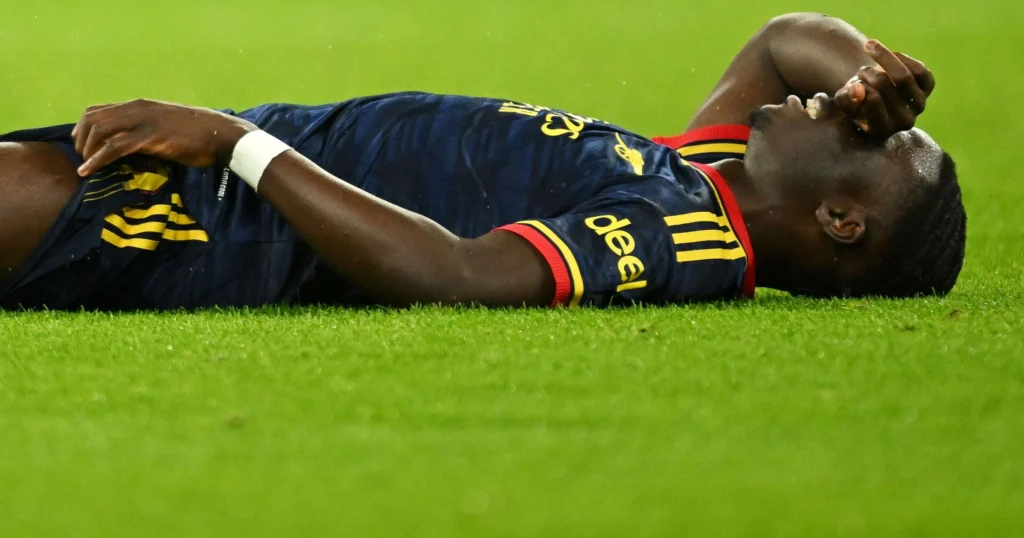
Arsenal without Bukayo Saka scored twice at Bayern Munich and left with a point. That was an encouraging first response to losing their winger, but it answered only part of the question facing Mikel Arteta.
Eberechi Eze came off the bench to score. Noni Madueke changed wings. Martin Odegaard supplied the opening goal, while Viktor Gyokeres later helped create Declan Rice’s equaliser.
The attacking responsibility was shared in the 2-2 draw at the Allianz Arena. If Saka is unavailable for longer, Arsenal will need to make that work repeatedly.
Arteta expressed concern after the match, but no confirmed recovery timetable has been established. The latest Saka injury update remains separate from the tactical question: how would Arsenal adapt if they have to play without him?
Arsenal without Bukayo Saka: Madueke offers the clearest route
Eze replaced Saka after 10 minutes, but he did not simply take over his position.
Madueke moved from the left wing to the right, with Eze coming into the side on the opposite flank, as detailed in the Standard’s report carried by Yahoo Sport.
That is the most straightforward arrangement for Arteta to consider again.
It keeps Odegaard in his central creative role and gives Arsenal a left-footed winger on the right. It also avoids requiring a wholesale change to the attack while the manager waits for clarity on Saka.
Madueke has already made a recent decisive contribution, scoring the winner in Arsenal’s victory at Nottingham Forest. He therefore has a case built on more than positional suitability.
The next test would be consistency. Replacing Saka involves providing an outlet throughout a match: receiving under pressure, combining with the players around him and making useful decisions when the first route towards goal is blocked.
A winning goal demonstrates what Madueke can contribute. A sustained run on the right would demand that broader influence too.
Eze’s goal showed what the reshuffle can offer
Eze’s opener in Munich was particularly useful evidence because of how it arrived.
Odegaard supplied the pass and Eze attacked the space on the left of the penalty area before finishing. Arsenal had lost their starting right winger, yet found a way through on the other side.
That gives Arteta something specific to build on. Eze can contribute by moving beyond the defence as well as coming towards the ball to create.
The distinction matters when Arsenal face opponents who restrict space centrally. If Eze, Odegaard and the striker all seek possession in similar areas, the attack can become easier to contain. Runs beyond the ball give the passer another option and force defenders to turn.
Munich supplied an example of that combination working. It did not establish that Eze and Madueke will reproduce Saka’s contribution between them every week.
Eze had been replaced at half-time against Forest, with Madueke subsequently providing the winner. Their contrasting contributions across the two matches underline why Arteta needs both players performing, rather than treating either as a complete solution.
Odegaard and the striker become part of the answer
The responsibility would also extend beyond the wings.
Odegaard’s pass for Eze and Gyokeres’ involvement in Rice’s equaliser showed two ways Arsenal could create without relying on Saka to make the final attacking action.
The first rewarded a run behind the defence. The second brought a midfielder into a scoring position through a combination with the centre-forward.
Those are useful patterns to develop. They allow Arsenal to threaten through different players and make it harder for opponents to concentrate their defensive attention on one side.
Gyokeres’ assist also gives Arteta a consideration in his choice of striker. It was evidence of a useful combination with Rice, although one action alone should not settle the selection between Gyokeres and Kai Havertz.
As our Arsenal player ratings against Bayern reflected, the strongest contributions came from several positions. That spread becomes more important if Saka misses games.
The bigger concern is the loss of choice
Arsenal’s immediate attacking options remain credible. The concern is how much flexibility disappears behind them.
Christos Tzolis was already unavailable for the Bayern match. A further absence would leave Arteta with fewer established wide options to rotate, introduce from the bench or use when a starting combination is struggling.
In Munich, Eze changed the game after being introduced. If he and Madueke both start, that particular option is no longer waiting among the substitutes.
Max Dowman offers another possibility, but it would be unreasonable to expect him to carry the responsibility of replacing an established senior attacker.
That is why the length of Saka’s absence matters so much. Covering one match and managing a sequence of fixtures present different problems.
Bayern offered encouragement, not a finished solution
Arsenal’s response in Germany showed they can retain an attacking threat after losing Saka. It also supplied a practical starting point: Madueke on the right, Eze on the left and Odegaard connecting the attack.
There are limits to what that result tells us. Bayern created chances of their own, David Raya made important saves and Arsenal needed a late equaliser. Two goals in an open European match do not guarantee the same productivity against a more compact defence.
If Saka cannot face Everton, Arteta’s task will be to turn the adjustment made in Munich into a prepared attacking plan.
The alternatives have supplied reasons for confidence. What Arsenal still need to establish is whether those individual contributions can become a reliable way of playing until Saka returns.
Related

Arsenal beat Slavia Prague 2-1 as Gyökeres scores and assists in Prague
Data + AI
Manchester City player ratings: Haaland decisive as Ndiaye impresses in Leipzig win
Human
RB Leipzig 2-3 Man City: Haaland winner settles five-goal Champions League contest
Human
Liverpool player ratings vs Fenerbahce: Nyoni and Isak earn 7s as Jacquet struggles in 3-2 defeat
Human
Fenerbahce 3-2 Liverpool: Reds throw away lead twice as Muriqi ends perfect European start
Human