 Premier League
 Championship
 EFL One & Two
 Scottish Premiership
 WSL
 Champions League
 Europa League
 FA Cup
 Carabao Cup
 Arsenal News
 Aston Villa News
 Chelsea News
 Liverpool News
 Man City News
 Man Utd News
 Newcastle News
 Tottenham News

 Premiership Rugby
 URC
 Six Nations
 Nations Championship
 Bath
 Leicester Tigers
 Saracens
 Northampton Saints
 Harlequins
 Bristol Bears
 Leinster
 Munster
 Glasgow Warriors
 Cardiff

Sets And Legs In Darts Explained: How Every Major Is Actually Won
Sets and legs in darts are the two units every match is built from, and mixing them up is the fastest way to misread a scoreline. A leg…
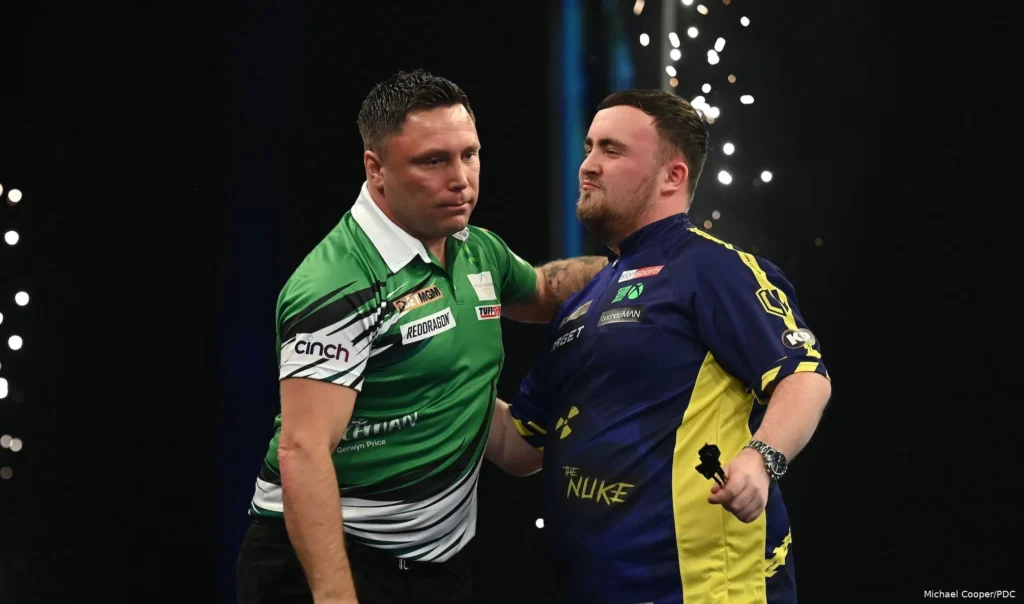
Sets and legs in darts are the two units every match is built from, and mixing them up is the fastest way to misread a scoreline. A leg is one game of 501. A set is a mini-match made up of legs. Most tournaments count legs only; a small, famous handful count sets — and that single choice changes how a match feels from the first dart. Here is how each one works, which majors use which, and what it does to the darts.
Sets and legs in darts: the short answer
A leg is a single game. Both players start on 501, throw three darts a visit, and the first to reduce their score to exactly zero with a double wins it. A set is a mini-match inside the match: the first player to win three legs takes the set. Match length is then quoted as a race — “first to 11 legs”, or “best of 13 sets”. Nearly every PDC event on the calendar is decided on legs alone. The two great exceptions are the World Championship and the World Grand Prix, both played in sets.
What is a leg in darts?
A leg is the basic unit of the sport. Both players begin on 501, take turns at three darts, and subtract what they score. The finish must land on a double or the bullseye, and it must be exact — go past zero, or land on one, and the visit is “bust”, the score reverts and the darts pass over. Those are the bones of the game, and we have set them out in full in our guide to the darts rules.
Who throws first matters. Players throw at the bull to decide who starts, and after that the throw alternates from leg to leg — which is why a deciding leg is so often described by who has the darts in it. Taking a leg against the throw is a “break”, and in a race to 11 or 18 a single break is frequently the whole match.
The perfect leg is nine darts, and it is rare enough that each one still makes headlines: we explain the maths behind it in what is a nine-dart finish. At the other end of the same idea, the biggest number that can be wiped out in a single visit is 170, the “big fish”.
What is a set in darts?
A set is three legs. Win three, and the set is yours no matter how the legs were shared — a 3–0 set and a 3–2 set are worth exactly the same. Sets are then stacked into a race of their own, so a best-of-13-set final is won by the first player to seven sets, and a player can lose comfortably more legs than their opponent and still win the match.
That is the crucial difference. In leg play every single leg is banked and counts towards one long total. In set play, legs are spent inside a container that empties every time somebody fills it. A five-leg burst in a leg race is a colossal chunk of the match; in set play it might be worth one set and a bit.
Which darts majors use sets, and which use legs
Set play is the format of the sport’s biggest stage. The PDC World Championship at Alexandra Palace is played in sets from the first round through to a best-of-13-set final — which is why Luke Littler’s second world title, won on 3 January 2026, is written down as a 7–1 win over Gian van Veen rather than a leg score.
The World Grand Prix is the other set-play major, and it stacks a second twist on top: the double-start, where players must open a leg on a double before they can begin scoring. Sets plus double-start is the most volatile combination in darts, and it is the reason the Grand Prix throws up more upsets than any other televised ranking event.
Everything else runs on legs. The World Matchplay in Blackpool builds to a marathon first-to-18-legs final — Littler beat Gerwyn Price 18–9 there in July 2026. The UK Open final is a first-to-11, which is how Littler’s 11–7 win over James Wade is recorded. Premier League league nights are short, sharp first-to-six races, with the O2 final stretched to first-to-11; Littler edged Luke Humphries 11–10 in the 2026 decider. The full schedule of what is still to come this year is in our darts calendar 2026.
Why the format changes the darts
Leg play rewards relentlessness. Over a first-to-18 in Blackpool there is nowhere to hide: a player throwing at a 100-plus three-dart average will usually grind an opponent down eventually, because every good leg goes straight into the bank.
Set play rewards timing. Because every set resets the count, a player can be outscored across the night and still win, provided they turn up in the legs that decide sets. It keeps underdogs alive far longer, it makes a single broken throw at the start of a set enormous, and it produces the long, swinging matches Ally Pally is built on. It also punishes slow starters less brutally — lose a set 3–0 and you have lost one unit, not three legs of a long race.
How to read a darts scoreline
A quick rule of thumb: small numbers usually mean sets, big numbers usually mean legs. A 7–1 at Alexandra Palace or a 6–2 at the Grand Prix is sets; a 16–12 or an 18–9 is legs. If in doubt, check the event — only the World Championship and World Grand Prix use sets among the PDC’s televised ranking majors, and the PDC’s official site lists the exact race length for every round of every tournament.
The next set-play test arrives quickly. The World Grand Prix runs from 28 September to 4 October, the first ranking major of the autumn and the one format quirk that has repeatedly caught out the sport’s heaviest scorers. Sets, doubles to start, and no way to simply out-throw the problem.
Follow Nine Dart News on X and Facebook for every darts result.
Related
How To Keep Score In Darts: 501, Chalking And The Maths Explained
Human Bogey Numbers In Darts Explained: The Scores You Cannot Check Out
Human Best Darts Players In The World Right Now: The 2026 Top 10
Human What Is The Bullseye In Darts? The 50, The 25 And The Big Fish
Human What Is A 180 In Darts? The Maximum Score Explained
Human