 Premier League
 Championship
 EFL One & Two
 Scottish Premiership
 WSL
 Champions League
 Europa League
 FA Cup
 Carabao Cup
 Arsenal News
 Aston Villa News
 Chelsea News
 Liverpool News
 Man City News
 Man Utd News
 Newcastle News
 Tottenham News
 Premiership Rugby
 URC
 Six Nations
 Nations Championship
 Bath
 Leicester Tigers
 Saracens
 Northampton Saints
 Harlequins
 Bristol Bears
 Leinster
 Munster
 Glasgow Warriors
 Cardiff

Diogo Dalot under pressure: Has the Man Utd defender run out of credit?
For Diogo Dalot, the uncomfortable moment came before Manchester United’s extraordinary escape. When his number went up against Aston Villa, sections of Old Trafford greeted his departure with…

For Diogo Dalot, the uncomfortable moment came before Manchester United’s extraordinary escape. When his number went up against Aston Villa, sections of Old Trafford greeted his departure with cheers.
Patrick Dorgu, the player who replaced him, would help turn another damaging defeat into a 4-4 draw. Dalot was left with a rather different contribution to reflect on: a difficult afternoon against Alysson and the penalty that handed Villa back the lead.
The late comeback changed the result. It should not end the discussion about his performance.
Dalot cannot reasonably be held responsible for everything wrong with Man Utd. But there is a legitimate question for Michael Carrick: what is the case for keeping him in the side when the alternatives are available?
Why Diogo Dalot is facing criticism
The frustration was audible inside the ground. The Times’ live coverage recorded a substantial cheer when Dalot’s number appeared on the substitution board, while talkSPORT’s post-match assessment questioned both his defending and Carrick’s continued faith in him.
That does not establish a unanimous verdict among United supporters. It does show the criticism extends beyond a handful of angry social media posts.
The penalty was the clearest reason for it. United had recovered from two goals down to reach half-time level. Shortly after the restart, Alysson beat Dalot, who extended a leg and brought him down. John McGinn converted.
It was a costly intervention at precisely the moment United needed composure. Having spent the first half repairing one disastrous start, they immediately gave themselves another problem.
Full-backs will lose individual duels. The judgement comes in what follows: whether to challenge, delay the attacker or rely on support. Dalot’s challenge allowed Villa to regain control of the scoreboard without having to finish the move.
Experience brings a higher expectation
Dalot is 27 and joined United in 2018. He is an established international and a senior member of the squad, rather than a young defender learning what Premier League football demands.
There is also a stronger player in his recent history than Sunday’s performance suggested. United named him their Players’ Player of the Year for 2023/24. The club’s official profile highlights his ability to operate on either flank and his availability, noting that he missed only one United match between December 2023 and January 2025.
Those qualities explain why managers have valued him. Versatility matters when injuries narrow the options, and dependable availability has obvious value across a long season.
Neither should make a starting place permanent.
The distinction is between being available for selection and doing enough to deserve selection. For an experienced defender, the standard must include making sound decisions when a match begins to turn against him.
Patrick Dorgu changes the selection discussion
Dorgu’s return gives Carrick another option. United confirmed before kick-off that this was his first involvement since September’s draw with Fulham.
His contribution was immediate and decisive: the cross for Joshua Zirkzee’s late goal, followed by the stoppage-time equaliser that rescued a point.
It would be too simple to treat that cameo as proof that Dorgu will solve United’s defensive problems. A substitute entering a game his team is chasing faces a different task from a starter managing the opening hour.
But he has earned consideration. Carrick now has to weigh the value of continuity against the possibility that a change would improve the side.
Dalot’s versatility should make him useful competition across the defence. It should not become a reason to accommodate him regardless of how he plays.
Man Utd’s problems go beyond one defender
There is a danger in making Dalot the explanation for an afternoon on which United conceded four. Senne Lammens and Leny Yoro also endured difficult moments, and the team’s repeated need to recover from two-goal deficits points to a wider failure.
Replacing one full-back will not automatically produce a settled defence. Carrick still has to establish a unit that protects its goalkeeper, responds to setbacks and gives the attack something less demanding than a rescue mission.
Individual accountability nevertheless has to exist within that collective responsibility.
Our report on United’s interest in Roma defender Wesley adds a recruitment dimension, although the reported interest does not establish that Dalot will be replaced or sold. The immediate decision concerns the next team sheet, not a hypothetical January transfer.
Dalot does not need to win an argument with supporters. He needs to give his manager a convincing footballing reason to select him.
Against Villa, that case became harder to make.
Related
Man Utd vs Aston Villa player ratings: Dorgu rescues United as Dalot struggles
Human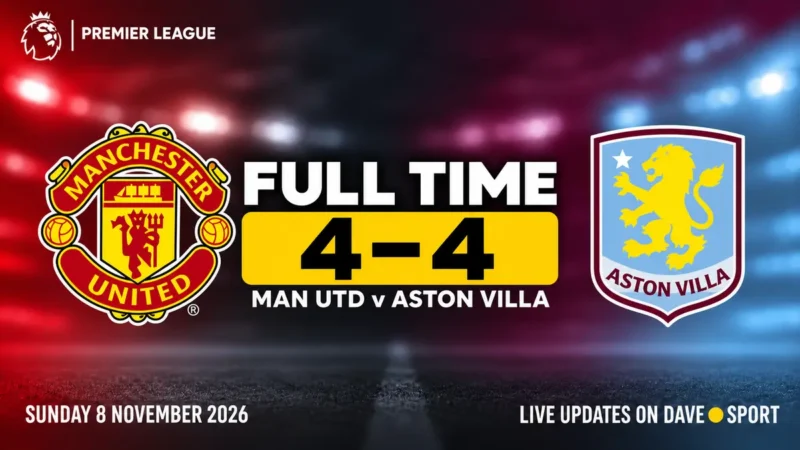
Man Utd 4-4 Aston Villa: Dorgu rescues point with dramatic late header
Human
WSL round-up: Russo lifts Arsenal as Crystal Palace win late thriller
Human
Ipswich vs Bournemouth player ratings: Evanilson impresses as Walton falters
Human
Brighton vs Brentford player ratings: Gomez stars as Thiago sees red
Human