 Premier League
 Championship
 EFL One & Two
 Scottish Premiership
 WSL
 Champions League
 Europa League
 FA Cup
 Carabao Cup
 Arsenal News
 Aston Villa News
 Chelsea News
 Liverpool News
 Man City News
 Man Utd News
 Newcastle News
 Tottenham News
 Premiership Rugby
 URC
 Six Nations
 Nations Championship
 Bath
 Leicester Tigers
 Saracens
 Northampton Saints
 Harlequins
 Bristol Bears
 Leinster
 Munster
 Glasgow Warriors
 Cardiff
Darts Terms Explained: Madhouse, Robin Hood And Every Bit Of Oche Slang
Darts terms are their own language, and nobody ever hands you the dictionary. You sit down to watch a PDC major, the commentator says a man has just…
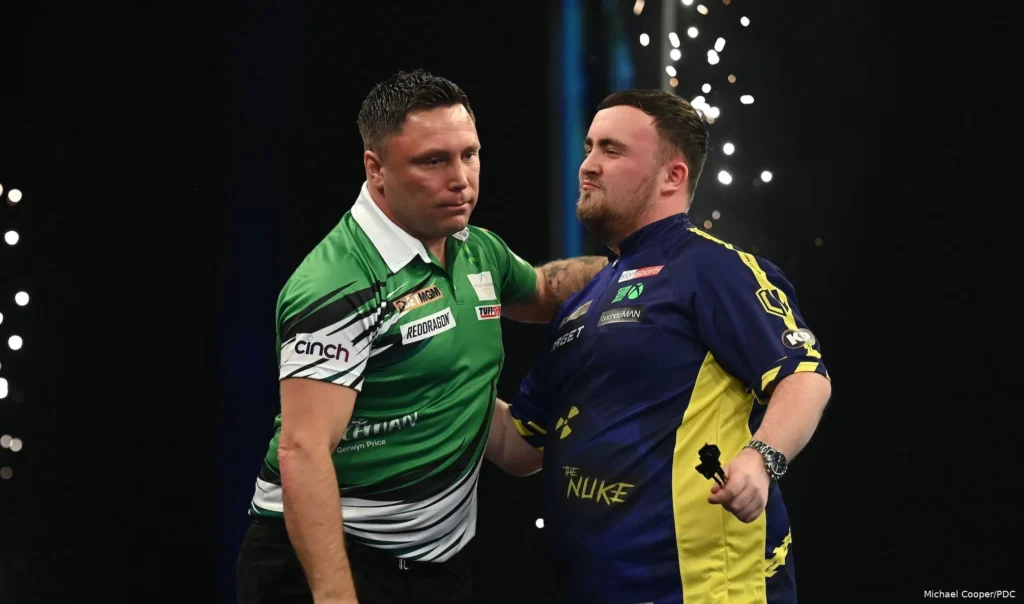
Darts terms are their own language, and nobody ever hands you the dictionary. You sit down to watch a PDC major, the commentator says a man has just hit a white horse but left himself in the madhouse, and you are expected to nod along. Here is the glossary that decodes it — the scores, the shots, the slang and the stats that darts fans throw around as if everyone was born knowing them.
Darts terms explained: the basics
Oche — the throw line. Pronounced "ockey". It sits 2.37m (7ft 9¼in) from the face of the board, measured horizontally, and stepping over it is the one rule even pub players enforce. Full measurements are in our guide to dartboard height and distance.
Visit — one turn of three darts. A player’s score is what those three darts total.
Ton — 100. From there the shorthand builds: ton-40 is 140, ton-60 is 160 and ton-80 is 180, the maximum score possible with three darts. A maximum and a 180 are the same thing.
Leg and set — a leg is one race from 501 to zero; a set is a mini-match of legs, used at the World Championship but not at Blackpool. We have unpicked the difference in sets and legs in darts explained.
The scores that have nicknames
Bed and breakfast — 26, usually scored 20, five, one. The name comes from the old two-and-six price of a night’s lodging. It is not a compliment.
Tops or double top — double 20, worth 40. The most popular finishing double in the sport, because it sits directly under the dart a player has thrown a thousand times.
Madhouse — double one. The last double left, the one you get stuck on, and the source of more televised misery than any other segment of the board.
Downstairs — the lower half of the board, the 19s and 16s, where players go when the treble 20 has stopped behaving.
The Big Fish — 170, the highest possible checkout: treble 20, treble 20, bullseye. There is nothing above it, which is why it gets its own name. Our piece on the highest checkout in darts explains why 170 is the ceiling.
The shots commentators shout about
Nine-darter — a perfect leg, 501 checked out in nine darts. The rarest routine event in the sport; see what a nine-dart finish actually is.
Shanghai — single, double and treble of the same number in one visit. Hit it on the 20 and you have scored 120 in style.
White horse — three different trebles in a single visit, none of them previously hit in that leg. Rarer than it sounds, and almost always accidental.
Robin Hood — a dart that lands in the back of a dart already in the board, splitting the flight. It looks spectacular and scores absolutely nothing.
Bounce-out — a dart that hits the wire and rebounds out of the board. Also scores nothing, and has cost players legs, matches and the odd tournament.
Spider — the metal framework dividing the board into its beds. Modern boards use thin blade wire precisely to cut bounce-outs down.
The numbers you cannot finish
Bogey numbers — scores that cannot be checked out in three darts no matter how you arrange them: 169, 168, 166, 165, 163, 162 and 159. Anything above 170 is impossible too. Good players actively avoid leaving them, which is why you will see someone throw at the 19 rather than the 20 late in a leg.
Bust — going below zero, leaving exactly one, or reaching zero without a double. The visit is void and the score reverts to what it was at the start of the turn. The full ruleset is in darts rules explained.
Format terms
Straight start — the normal way in, where a player simply begins scoring from 501.
Double start — you must hit a double before you can start scoring. Used at one televised major only, the World Grand Prix, which returns on 28 September and regularly humbles the best scorers in the world.
Against the darts / with the darts — whether you are throwing second or first in a leg. Winning a leg against the darts is a break of throw, and it is the moment matches turn.
Diddle for the middle — the throw at the bullseye that decides who starts. Also called bulling up.
The stats on your screen
Three-dart average — total points scored divided by darts thrown, multiplied by three. The single best measure of scoring power; our explainer on what counts as a good darts average puts the numbers in context.
Checkout percentage — doubles hit divided by doubles attempted. A player can average 105 and still lose if this figure collapses, which is the entire drama of darts in one line.
Checkout — the finish itself, the combination that takes a player from their remaining score to zero on a double.
Why the language matters
None of this is decoration. The slang exists because darts is a scoring sport played at speed, and the shorthand lets commentators keep up. When Luke Littler — the reigning world champion and PDC World No.1 — leaves 170 and the arena noise doubles before he has thrown, it is because several thousand people all did the same arithmetic at once and know exactly what is coming.
Learn twenty of these terms and a televised major stops being noise and starts being a conversation you are part of. Official rules, formats and fixture detail are published by the PDC, and the autumn calendar — Grand Prix, European Championship, Grand Slam and Players Championship Finals — gives you plenty of chances to practise.
Follow Nine Dart News on X and Facebook for every darts result.
Related
Luke Littler to miss Players Championship Finals as Anderson and Aspinall face last-chance battle
Human
Players Championship 33 and 34: how to watch, UK start times and the race for Minehead
Human
Fallon Sherrock ranking: why her £501,000 win does not count
AI
Fallon Sherrock beats Luke Littler to win £501,000 on Netflix
AI
Everything that matters in sport today, Friday 30 October 2026
Human