
 Premier League
 Championship
 EFL One & Two
 Scottish Premiership
 WSL
 Champions League
 Europa League
 FA Cup
 Carabao Cup
 Arsenal News
 Aston Villa News
 Chelsea News
 Liverpool News
 Man City News
 Man Utd News
 Newcastle News
 Tottenham News

 Premiership Rugby
 URC
 Six Nations
 Nations Championship
 Bath
 Leicester Tigers
 Saracens
 Northampton Saints
 Harlequins
 Bristol Bears
 Leinster
 Munster
 Glasgow Warriors
 Cardiff


How To Practise Darts: The Drills That Actually Improve Your Game
Most players who ask how to practise darts already own the answer they don't want to hear: standing at the oche flinging darts at treble 20 for an…
Most players who ask how to practise darts already own the answer they don’t want to hear: standing at the oche flinging darts at treble 20 for an hour is not practice. It is throwing. Practice has a target, a score and a record of whether you got better. Get that right and the improvement curve is steep, because the average club player is leaving enormous amounts of free points on the board.
How to practise darts: pick a purpose before you throw
Every session should answer one question. Am I working on scoring, finishing, or holding my nerve? Those are three different skills and they respond to three different drills. Blend them at random and you will spend 40 minutes doing whatever feels comfortable, which is usually the shot you are already good at.
Set the board up properly first, because a badly hung board bakes bad habits into your throw. The bullseye sits 1.73m from the floor and the oche is 2.37m back along the diagonal — the exact numbers are in our guide to dartboard height and distance. If your stance and release are still a work in progress, start with stance, grip and release before you chase numbers.
Scoring drills: 100 darts, one honest number
The cleanest scoring drill in darts is also the bluntest. Throw 100 darts at treble 20, add up everything you score, divide by 100 and multiply by three. That is your three-dart average for the session, measured the same way the PDC measures it on the official PDC scoreboard. Write it down. Do it weekly and you have a graph instead of a feeling.
Two refinements make it far more useful:
- Count your 26s. A single 20 either side of the treble is fine. A 5 or a 1 means your grouping is drifting sideways, not short.
- Switch beds deliberately. Spend a set of 30 darts on treble 19. Pros move to the 19s when the 20 bed is blocked or cold, and it needs to be a rehearsed shot rather than an emergency one.
For context on what the number you have just written down actually means, our explainer on what counts as a good darts average lays out the tiers from pub level to a 100-plus tour standard.
Doubles drills: where matches are actually lost
A leg of 501 must end on a double, so the double is the only shot in darts you cannot avoid. It is also the shot almost nobody practises properly, because missing it repeatedly is miserable.
Three drills that work:
- Doubles round the board. Double 1 to double 20, then the bull. Three darts per target, move on whether you hit it or not. Count total darts thrown — that is your score to beat next time.
- Bob’s 27. Start on 27 points and throw three darts at double 1. Each hit adds double the number, each complete miss subtracts it, then you move up to double 2, double 3 and so on. Go below zero and you are out. Brutal on the small doubles, brilliant for concentration.
- Favourite double, 20 visits. Most players finish on double 16 or double 20. Throw 60 darts at yours and log the hit rate. Anything above 40 per cent is genuinely strong.
Finishing drills: learn the combinations, not the maths
Good finishing is pattern recognition. From 81 you know it is treble 19, double 12 without thinking, and that split-second saved is a dart you can spend on the target instead of the arithmetic. Work through the standard routes with our darts checkout chart, then drill them: set yourself a number between 41 and 100, throw until you check out, log the darts, pick a new number.
Once the two-dart finishes are automatic, add the big ones. The 170 big fish is the ceiling, and the bogey numbers you cannot finish at all are covered in our full darts rules explainer — knowing which scores to avoid leaving is half of clever setting-up.
Match practice: play legs, not shots
Drills build the shots. They do not build the ability to hit a double when it matters, because a drill has no consequences. The fix is solo 501 legs against a target: give yourself 15 darts to win a leg, and treat anything longer as a loss. Track darts per leg across 20 legs and you have a number that maps directly onto match form.
Play in sets, too. Televised darts is not one long race — the sets and legs formats used at the majors reward players who can reset after losing three legs in a row, and you can rehearse exactly that at home.
How long, how often, and when to stop
Frequency beats duration. Four focused 30-minute sessions in a week will do more than one three-hour marathon, because darts is a repetition sport and fatigue teaches your arm the wrong thing. The moment your grouping falls apart, stop — you are now practising missing.
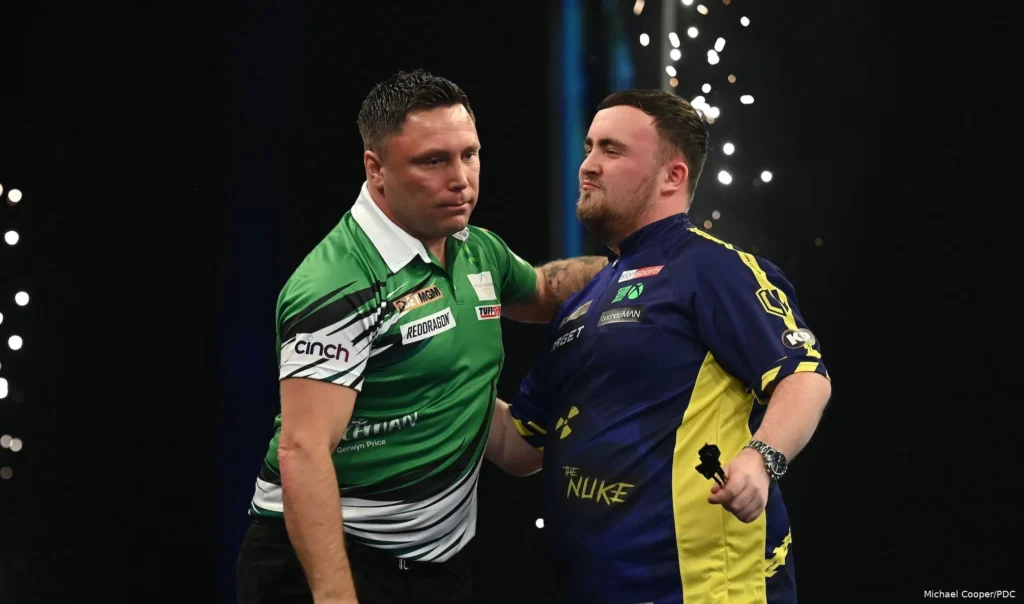
Keep a notebook or a phone note with three figures per session: session average, doubles hit rate, darts per leg. That is the whole system. Luke Littler is the reigning PDC world champion and world No.1 largely because a monstrous scoring power is bolted to a finishing game that does not flinch, and neither half of that arrives by accident. The floor players grinding the Pro Tour all know their numbers to a decimal point.
Practise with a purpose, write it down, and let the graph tell you the truth. It is a far better coach than the feeling you had after your last good leg.
Follow Nine Dart News on X and Facebook for every darts result.
Related
How To Keep Score In Darts: 501, Chalking And The Maths Explained
Human Bogey Numbers In Darts Explained: The Scores You Cannot Check Out
Human Best Darts Players In The World Right Now: The 2026 Top 10
Human What Is The Bullseye In Darts? The 50, The 25 And The Big Fish
Human What Is A 180 In Darts? The Maximum Score Explained
Human