
 Premier League
 Championship
 EFL One & Two
 Scottish Premiership
 WSL
 Champions League
 Europa League
 FA Cup
 Carabao Cup
 Arsenal News
 Aston Villa News
 Chelsea News
 Liverpool News
 Man City News
 Man Utd News
 Newcastle News
 Tottenham News

 Premiership Rugby
 URC
 Six Nations
 Nations Championship
 Bath
 Leicester Tigers
 Saracens
 Northampton Saints
 Harlequins
 Bristol Bears
 Leinster
 Munster
 Glasgow Warriors
 Cardiff


Why are Premiership scores so high? The answer goes beyond bad defending
Northampton and Bath shared 119 points, but the league’s rush of tries began before Saturday. A greater appetite for risk helps explain it — and defence still matters.
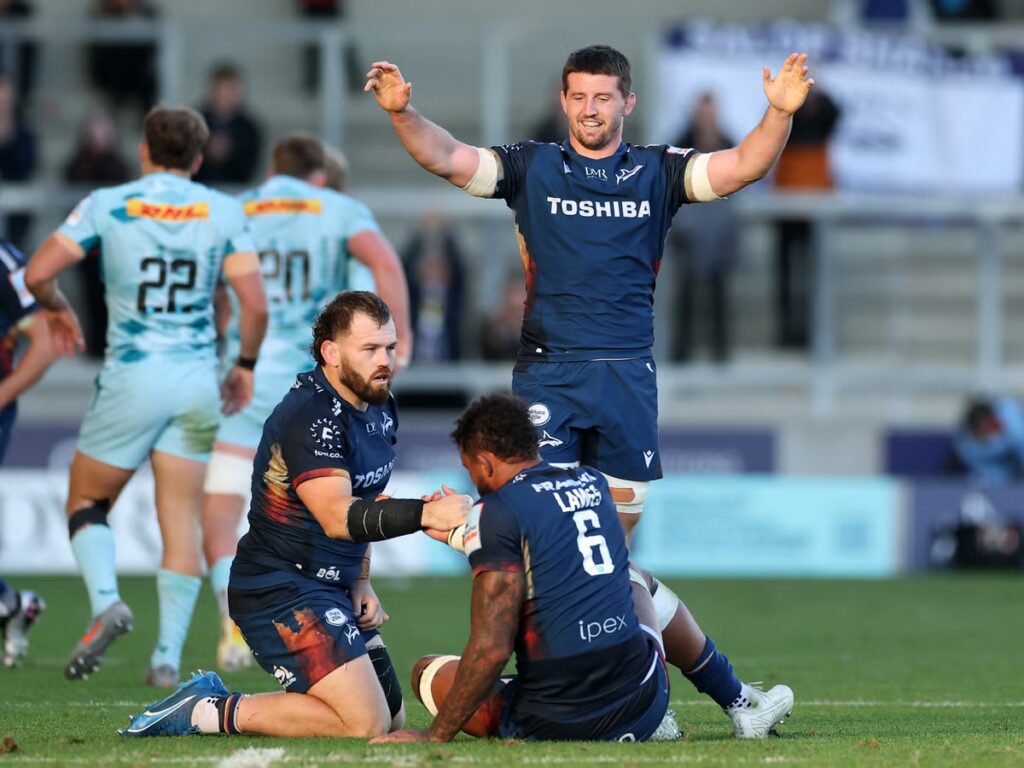
Northampton and Bath shared 119 points, but the league’s rush of tries began before Saturday. A greater appetite for risk helps explain it — and defence still matters.
Scoring 48 points away from home would ordinarily give a rugby side good reason to expect victory. Bath managed it at Northampton on Saturday and lost by 23.
Saints’ 71–48 win produced 18 tries and the second-highest aggregate score in Premiership history. It was an extraordinary afternoon, even by the standards of a season that has started at a remarkable scoring rate.
The temptation is to treat such a scoreline as evidence that defending has become optional. Northampton director of rugby Phil Dowson offered a more useful explanation: teams are increasingly willing to attack opportunities that they might previously have kicked away.
That helps explain the spectacle. It does not excuse every missed tackle.
Premiership scoring was rising before Northampton’s 71–48 win
Across the opening two rounds, the Premiership produced 93 tries in 10 matches — an average of 9.3 per game.
According to Opta figures reported by The Times, that was the highest average for the opening two rounds since its records began in 2007–08. The opening weekend alone supplied 52 tries. These figures cover the first two rounds, before the latest weekend’s fixtures.
| Period | Matches | Tries | Tries per match |
|---|---|---|---|
| Opening round | 5 | 52 | 10.4 |
| Opening two rounds combined | 10 | 93 | 9.3 |
| Northampton v Bath, round three | 1 | 18 | 18.0 |
Saturday’s result was therefore an extreme example of an existing pattern. It cannot, by itself, tell us how the rest of the season will unfold.
Teams are more willing to counter-attack
Dowson’s explanation starts with the opportunities available when possession changes hands.
In his post-match comments reported by RugbyPass, he pointed to changes around kicking, the availability of broken-field possession and a greater willingness to move the ball before choosing to kick.
“I think risk is being rewarded more often,” he said.
The distinction is important. Attacking a defence that is still reorganising presents a different challenge from repeatedly carrying into a settled line.
Dowson’s assessment suggests teams increasingly see those moments as opportunities worth taking. The possible reward has to be weighed against the danger of losing possession, but an immediate kick is no longer necessarily the preferred response.
It is an explanation from one coach, rather than proof that every club has adopted the same approach. It does, however, offer more substance than simply pointing at the scoreboard.
Better handling makes more players a threat
Dowson also highlighted the skills now expected of forwards.
Speaking to Planet Rugby, he argued that improved handling across the playing group, supported by training facilities, places greater demands on defenders. He also described teams choosing to kick penalties towards the corner and build pressure rather than consistently taking shots at goal.
Those choices can reinforce one another. More players able to pass effectively give an attack more options; pursuing tries from penalties creates further opportunities to use them.
That is a plausible part of the explanation for higher scores. Establishing how much each factor contributes would require broader data on possessions, penalty decisions and the origins of tries.
Bath’s mistakes still mattered
None of this means every try at Franklin’s Gardens was unavoidable.
Bath director of rugby Johann van Graan identified errors that gave Northampton opportunities, alongside costly indiscipline. His side led 29–26 at half-time and moved 10 points clear shortly after the restart, yet could not protect that advantage.
Our Northampton–Bath analysis examines the decisive second-half swing. Saints scored 45 points after the interval; Bath added 19.
The official Bath match centre records seven different Northampton try-scorers. The threat came from several positions, but Bath’s inability to interrupt the scoring remained central to the result.
Saracens supplied a useful counterpoint
Elsewhere on Saturday, Saracens beat Bristol 30–7. On the same day that Bath conceded 11 tries, another Premiership side restricted its opponents to seven points.
That result should temper sweeping conclusions about defending across the competition.
The early figures show an unusually prolific start. Dowson’s comments suggest changing decisions and broader attacking skills are helping drive it. Northampton and Bath also demonstrated how errors can accelerate the scoring once a match becomes open.
The challenge for the contenders is to retain that attacking ambition while conceding fewer opportunities themselves. Scoring freely gives a team options. As Bath discovered, it does not guarantee control.
Related

Alex Mitchell ruled out of England’s Australia clash as Spencer and Randall return to injury-hit squad
Human
Northampton 28-14 Gloucester: Hendy and Hutchinson give Saints winning response
AI
Bath 36-28 Sale Sharks: Joe Cokanasiga double helps hosts return to winning ways
AI
Saracens 39-31 Newcastle: Six second-half tries overturn visitors’ lead
AI
Exeter Chiefs 28-31 Harlequins: Lucas Schmid double settles nine-try thriller
AI