
 Premier League
 Championship
 EFL One & Two
 Scottish Premiership
 WSL
 Champions League
 Europa League
 FA Cup
 Carabao Cup
 Arsenal News
 Aston Villa News
 Chelsea News
 Liverpool News
 Man City News
 Man Utd News
 Newcastle News
 Tottenham News
 Premiership Rugby
 URC
 Six Nations
 Nations Championship
 Bath
 Leicester Tigers
 Saracens
 Northampton Saints
 Harlequins
 Bristol Bears
 Leinster
 Munster
 Glasgow Warriors
 Cardiff

Northampton vs Bath analysis: how 48 points still left the visitors well beaten
Any Northampton vs Bath analysis has to begin with the apparent contradiction: Bath scored seven tries, led at half-time and extended their advantage after the restart, yet finished…
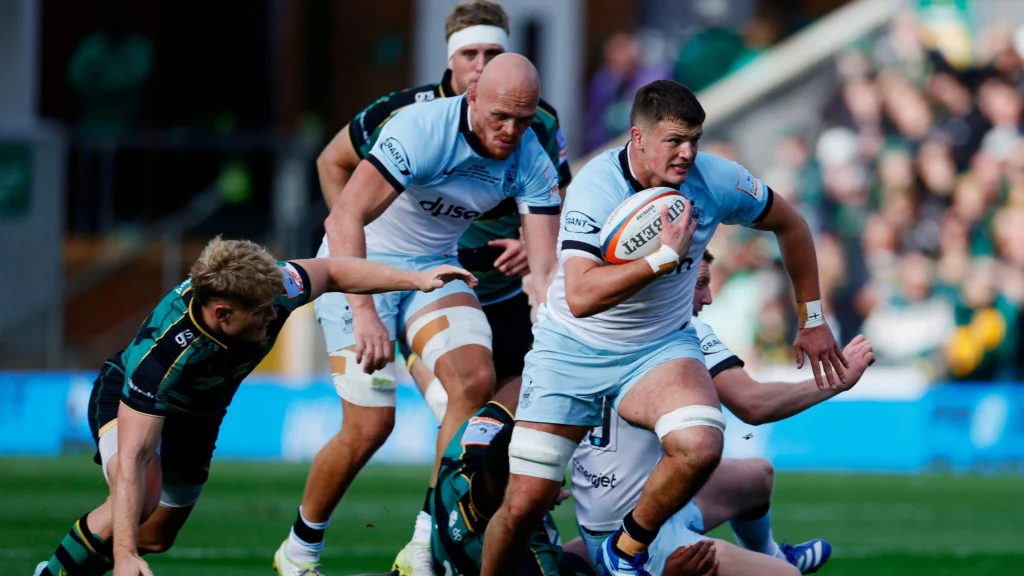
Any Northampton vs Bath analysis has to begin with the apparent contradiction: Bath scored seven tries, led at half-time and extended their advantage after the restart, yet finished 23 points behind.
Northampton’s 71–48 victory at Franklin’s Gardens produced 18 tries and the second-highest aggregate score in the competition’s history.
Ollie Sleightholme supplied a hat-trick, Tommy Freeman scored twice and Saints finished with 11 tries. But the decisive feature was how they sustained their scoring after Bath could no longer match them.
The interval offered little indication of the final margin. Bath were 29–26 ahead, and Arthur Green’s second try helped stretch that lead to ten points early in the second half.
Northampton then won the remainder of the contest emphatically.
Northampton vs Bath analysis: the second-half swing
The scoring breakdown captures the change.
| Period | Northampton | Bath |
|---|---|---|
| First half | 26 | 29 |
| Second half | 45 | 19 |
| Full-time | 71 | 48 |
Bath remained dangerous after the break. Green scored again, Santi Carreras crossed and Josh Bayliss later added their seventh try.
Northampton, however, scored seven second-half tries through James Pater, Josh Kemeny, Alex Mitchell, Sleightholme twice, Alex Coles and Freeman. The sequence is recorded in Bath’s official match centre.
That difference explains why Bath’s attacking output was insufficient. Their defence repeatedly left them needing another score simply to remain within reach.
Scoring 48 points should give a team several opportunities to establish control. Here, Bath could not make their advantages last.
Northampton attacked through different routes
Saints’ comeback contained more variety than a succession of finishes out wide.
Pater capitalised on Carreras failing to gather a pass. Kemeny finished from Coles’ delivery. Mitchell then collected his own kick ahead for an individual try that put Northampton back in front.
Later, Fin Smith’s carry helped create Coles’ score, while the handling of Rory Hutchinson and Anthony Belleau opened the way for Freeman’s second.
Those moments, detailed in Sky Sports’ match report, show several different problems being put to Bath’s defence.
Northampton could exploit a loose ball, use a kick to get beyond defenders or move possession through supporting runners. Bath therefore needed more than one successful defensive adjustment.
The spread of scorers reinforces that point. Sleightholme and Freeman finished five tries between them, but six other Saints players also crossed. The threat extended through the side.
Bath’s mistakes became increasingly expensive
Johan van Graan’s assessment centred on the moments his team gave away.
“Ultimately, they punished us on our mistakes,” the Bath director of rugby said, in comments reported by AFP.
Pater’s try was a clear example. Bath had just established their largest lead, only for an error in possession to provide Northampton with an immediate route back.
That kind of response changes the value of the preceding score. Bath had earned breathing space, but could not use it to make Northampton chase the game for a sustained period.
There was also a personnel disadvantage during an important passage: Ollie Lawrence was sin-binned in the second half. Bath had already spent time without Bayliss before the interval. The BBC’s syndicated report records both yellow cards.
Against an attack producing opportunities so regularly, those periods increased an already difficult defensive workload.
The selection context matters
Bath made 12 changes for the trip, according to the same BBC report. That is relevant when assessing how representative this performance was of their strongest combination.
It does not remove the defensive problems. It does caution against treating one heavily changed team’s performance as a complete verdict on Bath’s season.
Their attack still produced seven tries away from home. Green scored twice, while Charlie Griffin marked his Premiership debut with a try.
The coaching review therefore has useful attacking work to preserve alongside substantial defensive problems to address. Bath’s challenge is to keep creating opportunities while reducing the frequency with which opponents receive equally promising ones.
Saints have their own balance to find
Phil Dowson linked the attacking spectacle to teams becoming more willing to use counter-attacking opportunities.
“I think risk is being rewarded more often,” he said.
Northampton’s execution gave that approach a spectacular return. Yet conceding seven tries means their review cannot focus exclusively on the quality of their attack.
The first half left them behind despite scoring four tries. Early in the second, they were ten points down. Those are significant concessions even on a day that eventually produced a comfortable victory.
For Saints, the strongest lesson from this match is that they have several ways to score and the ability to keep executing them under pressure. Improving their defending would allow that attacking quality to establish control sooner.
For Bath, the priority is more immediate: make scoring passages count by protecting the territory, possession and leads that follow them.
Our rugby coverage will follow how both sides respond. This extraordinary match has left each coaching team with plenty to examine.
Related
Alex Mitchell ruled out of England’s Australia clash as Spencer and Randall return to injury-hit squad
Human
Northampton 28-14 Gloucester: Hendy and Hutchinson give Saints winning response
AI
Bath 36-28 Sale Sharks: Joe Cokanasiga double helps hosts return to winning ways
AI
Bath vs Sale Sharks team news: Arundell returns, Wheeler set for debut and Lawes absent
AI
How to watch Bath vs Sale Sharks: TV channel, live stream and kick-off time
AI