
 Premier League
 Championship
 EFL One & Two
 Scottish Premiership
 WSL
 Champions League
 Europa League
 FA Cup
 Carabao Cup
 Arsenal News
 Aston Villa News
 Chelsea News
 Liverpool News
 Man City News
 Man Utd News
 Newcastle News
 Tottenham News

 Premiership Rugby
 URC
 Six Nations
 Nations Championship
 Bath
 Leicester Tigers
 Saracens
 Northampton Saints
 Harlequins
 Bristol Bears
 Leinster
 Munster
 Glasgow Warriors
 Cardiff


Newcastle had 16 shots — so why did they barely trouble Aston Villa?
The Newcastle attack finished Saturday’s defeat by Aston Villa with 16 shots and one troubling detail: the only player to make Zion Suzuki save was Sven Botman.
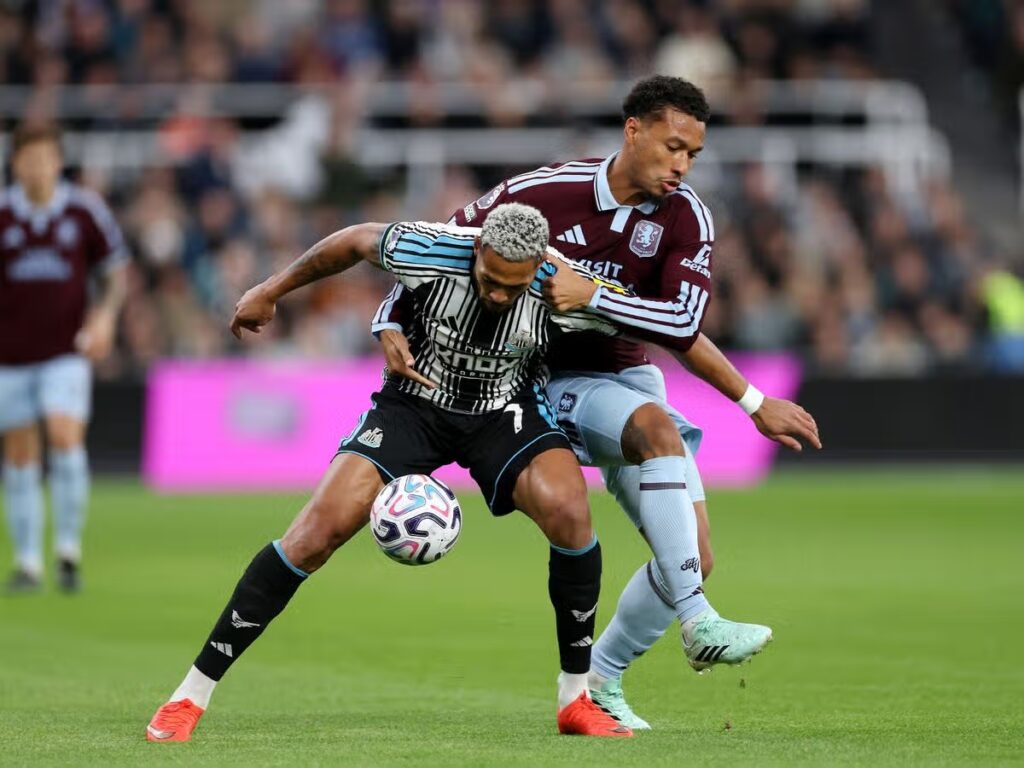
The Newcastle attack finished Saturday’s defeat by Aston Villa with 16 shots and one troubling detail: the only player to make Zion Suzuki save was Sven Botman.
A centre-back supplied the hosts’ solitary effort on target in a game they spent almost an hour chasing. Johan Manzambi’s first-half header settled the 1-0 defeat at St James’ Park, leaving Matthias Jaissle with questions about how his side turn attacking possession into genuine danger.
Yoane Wissa’s finishing will attract scrutiny. So should the positions from which Newcastle asked their forwards to shoot.
The most revealing figure is the number of attempts Villa prevented from reaching their goalkeeper.
The Newcastle attack kept running into defenders
Nine of Newcastle’s 16 shots were blocked, according to StatMuse’s match data. More than half their attempts ended against an opponent before Suzuki needed to intervene.
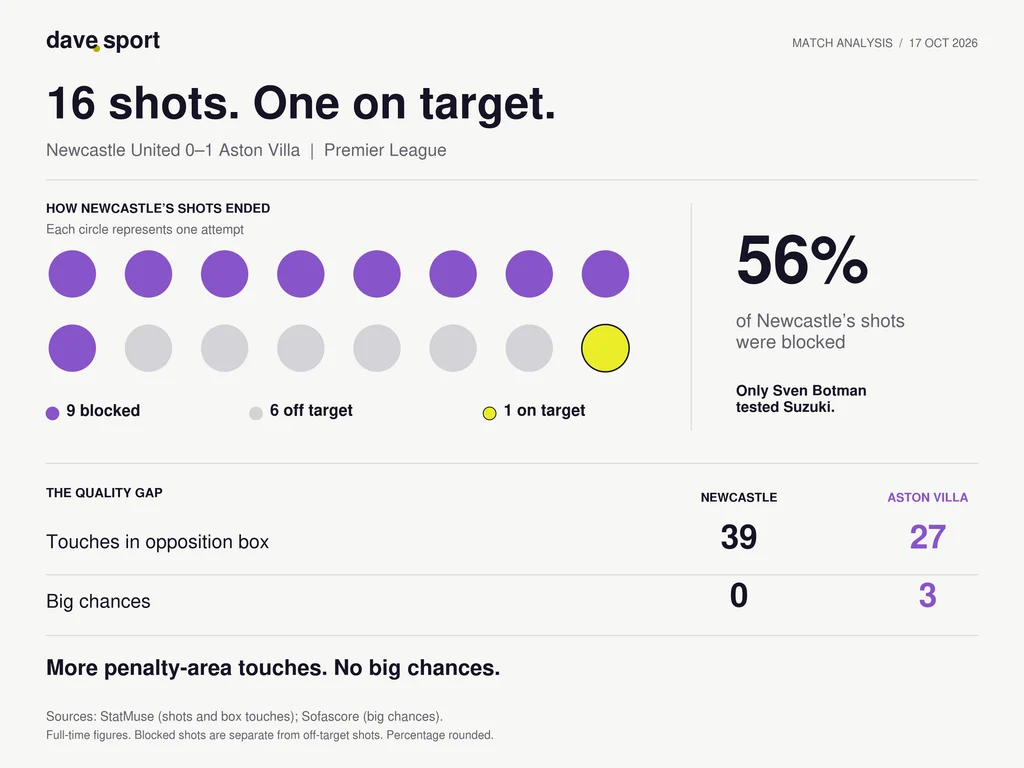
That helps explain how a respectable shot count produced such a limited examination of the goalkeeper.
| Statistic | Newcastle | Aston Villa |
|---|---|---|
| Shots | 16 | 15 |
| Shots on target | 1 | 3 |
| Shots blocked | 9 | 8 |
| Touches in opposition box | 39 | 27 |
| Expected goals | 1.07 | 1.50 |
Figures: StatMuse.
Newcastle reached Villa’s penalty area often enough to accumulate 39 touches there. Their difficulty was turning those visits into clear shooting opportunities.
The blocked efforts suggest Villa repeatedly had bodies in position to intervene. They cannot, on their own, explain whether a quicker decision or a different pass would have beaten the defender. They do make the final action an obvious area for Jaissle to examine.
Villa also had eight shots blocked. The difference was that the visitors created three big chances, while Newcastle were credited with none.
Wissa’s finishing deserves scrutiny
Wissa attempted seven shots without putting one on target.
His most frustrating moment came late on, when he carried the ball forward impressively before losing control of the finish and shooting wide. Earlier, Joelinton had supplied another opportunity that he failed to direct on target.
Those were moments in which Newcastle needed greater composure from their centre-forward. Wissa carries responsibility for how he used them.
But his attempts also included an acrobatic effort before half-time, a looping header over the bar and a scissor kick blocked by Boubacar Kamara. That variety matters when assessing the service he received. Newcastle’s own official match report acknowledged their difficulty creating clear opportunities after the interval.
A striker improvising under pressure can produce a memorable goal. Building an attack that regularly requires those finishes leaves little margin for error.
Jaissle needs to improve both the supply and the execution. Changing the player at the end of the move would address only part of Saturday’s problem.
Twenty-eight crosses brought little reward
Newcastle delivered 28 crosses, with four finding a team-mate, according to Sofascore. Villa completed two from nine.
Crossing accuracy is an imperfect measure: a dangerous delivery can force a clearance or create a second ball without being recorded as successful. Even so, Newcastle’s return invites questions about the deliveries, the movement inside the box and the decisions to cross.
The comparison with Villa’s winner was particularly uncomfortable. João Gomes supplied from the right and Manzambi arrived to head home. Newcastle needed a similar connection between the player delivering and the player attacking the space.
The temptation when chasing a game is to keep sending the ball towards goal. Jaissle should be asking his players to recognise when an extra combination, a run beyond the full-back or a pass back towards the penalty spot offers a better opening.
Those are ways to make defenders turn and change position before the shot arrives.
What Jaissle should change first
Jaissle did try to alter the attack. William Osula and Bazoumana Touré replaced Joe Willock and Matias Fernandez-Pardo during the second half, before Dan Burn was introduced as an additional forward late on.
That increased his attacking options, but the case for the next selection should centre on how those players combine.
Who provides width? Who supports the striker closely enough to exchange a quick pass? Who attacks the space when a defender steps towards the ball? Those responsibilities need to be clear whichever forwards start.
Before kick-off, Jaissle had directed attention towards improving his own players when asked about Newcastle’s unsuccessful pursuit of Manzambi. Saturday supplied a specific task for that work.
My view is that Newcastle should prioritise creating cleaner shooting positions before making another wholesale attacking reshuffle. Wissa’s place is open to debate, but any replacement will need better opportunities too.
The next sign of progress should be a goalkeeper forced into repeated saves, with Newcastle’s forwards receiving the ball in positions from which they can finish decisively.
Related

Luke Humphries wins Players Championship 33 as Aspinall misses Finals
Data + AI
Osleys Iglesias vs Canelo Alvarez: Malignaggi says IBF champion is ‘too good and not popular enough’
Data + AI
Luke Littler retirement: Phil Taylor suggests world No 1 could quit ‘in five years’
Data + AI
Shea Lacey gives Michael Carrick an Aston Villa selection decision after helping Manchester United rescue Roma win
Human
Aston Villa player ratings vs Barcelona: Jackson offers resistance as Emery’s side suffer first European defeat
Human