 Premier League
 Championship
 EFL One & Two
 Scottish Premiership
 WSL
 Champions League
 Europa League
 FA Cup
 Carabao Cup
 Arsenal News
 Aston Villa News
 Chelsea News
 Liverpool News
 Man City News
 Man Utd News
 Newcastle News
 Tottenham News

 Premiership Rugby
 URC
 Six Nations
 Nations Championship
 Bath
 Leicester Tigers
 Saracens
 Northampton Saints
 Harlequins
 Bristol Bears
 Leinster
 Munster
 Glasgow Warriors
 Cardiff

Henry Pollock’s wing cameo gives Borthwick a new answer to England’s bench dilemma

Henry Pollock’s two tries against Australia gave England an immediate reward for trusting him on the wing. The greater benefit could come when Steve Borthwick next sits down to choose his replacements.
With Immanuel Feyi-Waboso unable to continue after half-time, the Northampton Saints back-row forward covered the position for 40 minutes in Sunday’s 45-22 win. England absorbed the loss of a specialist winger and still found an attacking threat on that side of the pitch.
For Borthwick, that is evidence he can use. A forward-heavy bench depends partly on what happens when an injury forces a player into an unfamiliar role. Against Australia, Pollock helped make the arrangement work.
Henry Pollock on the wing was a plan, not a last-minute guess
Borthwick said England had been preparing Pollock for the role for more than a year, according to Reuters’ report of his post-match comments. The coach also said Pollock’s speed compared with that of England’s specialist wings.
That preparation changes how the substitution should be judged. The move may have looked unusual, but the coaches had already considered the possibility and worked towards it.
The important question was whether that preparation would survive a Test match. Pollock’s second half gave Borthwick a much stronger answer than another successful training session could have provided.
Why Henry Pollock matters to the six-two bench
A six-two split means selecting six forwards and two backs among the eight replacements. It gives a coach an extra forward to introduce, but reduces the number of specialist backs available if injuries disrupt the starting side.
England used that balance against Australia. When Feyi-Waboso went off, Pollock’s ability to move wide helped them cover the absence without immediately relying on one of the two replacement backs.
Borthwick addressed that calculation directly in comments reported by RugbyPass. He discussed how players covering more than one position influence the choice between six-two and five-three, and cited Ben Earl’s experience in the centres.
Pollock now gives that discussion another practical example. A replacement can be selected for his work in the pack while also offering an answer elsewhere. That increases the coach’s freedom when deciding which skills he wants available late in a match.
The two tries were the reward, but coverage is the bigger point
Pollock’s double helped England pull away after Australia had reduced the gap to 19-10 at half-time. Our England–Australia match report covers the seven-try victory in full.
The temptation is to turn those finishes into a selection campaign. There is a more useful conclusion to draw: England have a forward who has shown he can contribute from the wing when a match demands it.
That does not remove the value of a specialist. Wing play also involves positioning under kicks, coordinating the edge of the defence and choosing when to leave the touchline. A two-try return is compelling, but it is only part of the assessment.
Nor does one successful substitution make a six-two bench the answer to every opponent. The balance still depends on the starting backline, available cover and the kind of game Borthwick expects.
What does it mean for England against Japan?
England next face Japan at Twickenham on Saturday 14 November. Feyi-Waboso’s availability remains an important part of the preparation; our Feyi-Waboso injury update sets out what has been confirmed about his ankle.
There are two distinct decisions ahead: who should start on the wing, and who can cover it from the bench. Pollock’s performance strengthens his usefulness in the second discussion without automatically settling the first.
If England retain a forward-heavy bench, Borthwick can point to a Test in which the contingency was needed and delivered. If he chooses more specialist back cover, Pollock’s extra role still remains available within the match.
Henry Pollock has given his coach another credible option. That may prove more valuable across the autumn than the novelty of seeing a flanker finish twice out wide.
Related

Steve Borthwick: Itoje hails ‘world-class’ coach after Australia rout
Human
Henry Pollock scores twice for England after switch to wing
Human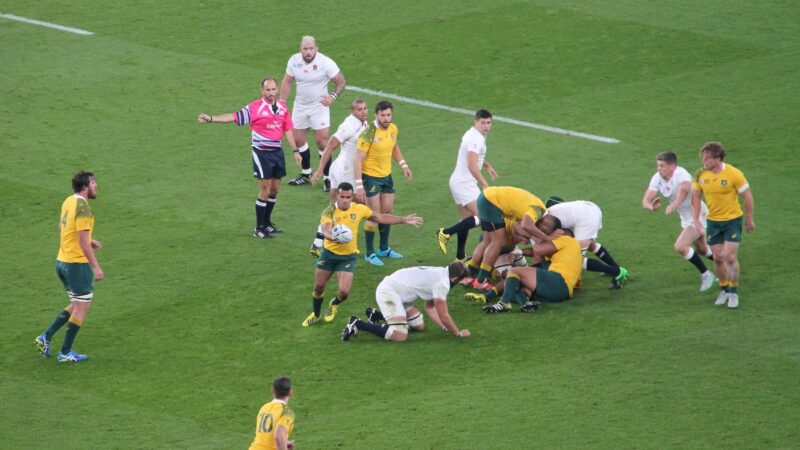
England vs Australia: Hosts score seven tries in 45-22 Twickenham win
Human
Immanuel Feyi-Waboso injury: England await ankle checks after Australia win
Human
Wales 28-21 Japan: Josh Adams double seals bonus-point win
AI