 Premier League
 Championship
 EFL One & Two
 Scottish Premiership
 WSL
 Champions League
 Europa League
 FA Cup
 Carabao Cup
 Arsenal News
 Aston Villa News
 Chelsea News
 Liverpool News
 Man City News
 Man Utd News
 Newcastle News
 Tottenham News
 Premiership Rugby
 URC
 Six Nations
 Nations Championship
 Bath
 Leicester Tigers
 Saracens
 Northampton Saints
 Harlequins
 Bristol Bears
 Leinster
 Munster
 Glasgow Warriors
 Cardiff

Issa Diop avoids red card against Nottingham Forest as Premier League explains James McAtee decision
Issa Diop avoided a red card against Nottingham Forest because referee Thomas Bramall judged that James McAtee’s touch away from goal and the presence of defensive cover meant…
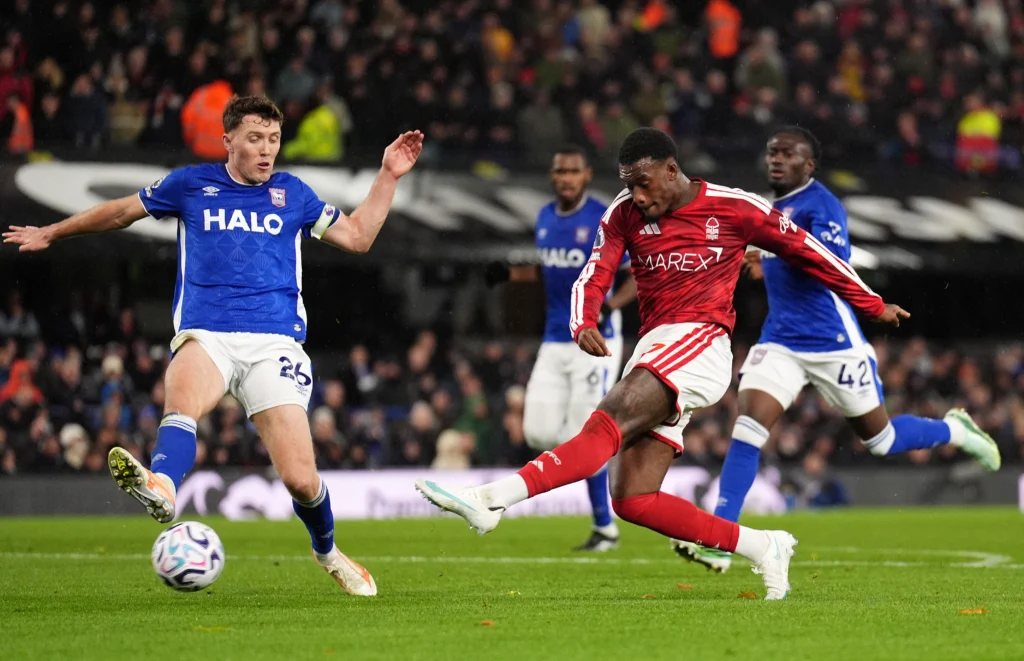
Issa Diop avoided a red card against Nottingham Forest because referee Thomas Bramall judged that James McAtee’s touch away from goal and the presence of defensive cover meant the foul had stopped a promising attack rather than denied an obvious goalscoring opportunity.
The Ipswich defender received a yellow card after an on-field review during Friday’s 1–1 draw at Portman Road.
The Premier League’s official explanation records Bramall’s assessment: “It’s a heavy touch, with the defender inside and he knocks the ball away from the goal”.
What happened between Diop and McAtee?
McAtee pushed the ball past Diop early in the second half before the defender brought him down outside the penalty area.
Bramall initially allowed play to continue. VAR subsequently recommended a review for a possible red-card offence, with the referee going to the pitchside monitor.
He returned to award Forest a direct free-kick and caution Diop. As talkSPORT reported, the outcome frustrated Forest manager Oliver Glasner.
Why being the last defender does not automatically mean red
The test in IFAB’s Law 12 is whether the offence denied an obvious goalscoring opportunity. Being described as the “last man” does not settle that question.
Officials must consider how far the incident is from goal, the direction of play, whether the attacker is likely to retain or gain control, and the positions and numbers of defenders and attackers.
A touch towards the side of the penalty area does not automatically rule out a red card either. Those factors must be assessed together.
The distinction is between an attack with potential and an opportunity clear enough to meet the dismissal threshold. Supporters can disagree with the referee’s assessment of the positions without those positions being irrelevant to the decision.
Why could a VAR review end with a yellow card?
A review for a possible dismissal does not oblige the referee to send a player off.
Under IFAB’s VAR protocol, a possible denial of an obvious goalscoring opportunity is a reviewable incident. The referee retains responsibility for the final decision and can apply the appropriate sanction after examining the footage.
That means an incident reviewed as a potential red card can end with a free-kick and a caution. The review concerns the possible sending-off offence; the eventual punishment depends on what the referee concludes.
Ipswich hold on for a point
The incident came with the teams level after Julio Enciso had cancelled out Neco Williams’ opener.
Forest continued to create opportunities but could not find a winner. Our Ipswich–Forest match centre contains the result, key events and match statistics.
The visitors’ failure to convert their chances remains a separate issue from the refereeing decision, and follows the concerns examined in our analysis of Liam Delap and Nottingham Forest’s scoring problems.
Related
Brian Brobbey signs new Sunderland contract until 2031 as striker targets more after European breakthrough
Human
Newcastle struggle for answers as Carragher warns of tough season after another Everton defeat
Human
Premier League winners and losers: Brighton make history as Arsenal go clear and Man Utd slide
Human
Alexander Isak penalty appeal: Liverpool denied spot-kick after Jurrien Timber shirt-pull in Arsenal defeat
Human
Liverpool vs Arsenal: Kai Havertz seals 1–0 win as Gunners end long wait for Anfield victory
Human